
Let’s address the elephant in the room: relying solely on your Amazon affiliate links leaves money on the table. With Amazon representing a portion of U.S. e-commerce, limiting yourself to single-retailer links means you’re potentially missing a significant portion of buyers. Plus, Google now explicitly recommends linking to multiple sellers in product reviews. Today, we’ll show you exactly how to build a multi-retailer affiliate content strategy that captures more revenue while future-proofing your rankings.
Why Multi-Retailer Linking Is Worth Adding to Your Strategy
Single-retailer affiliate strategies aren’t broken. Amazon remains the dominant player in U.S. e-commerce, and for many publishers it’s still the biggest earner. But there’s a real opportunity being missed by relying on it exclusively. Shopping behavior isn’t uniform: some buyers default to Amazon out of habit, others comparison-shop, and some have strong preferences for specific retailers based on return policies, pickup options, or pricing. A multi-retailer approach doesn’t replace your Amazon links; instead, it adds a layer that captures the sales you’re currently losing to shoppers who leave and buy elsewhere.
Understanding Google’s Product Review Update & Multi-Retailer Requirement
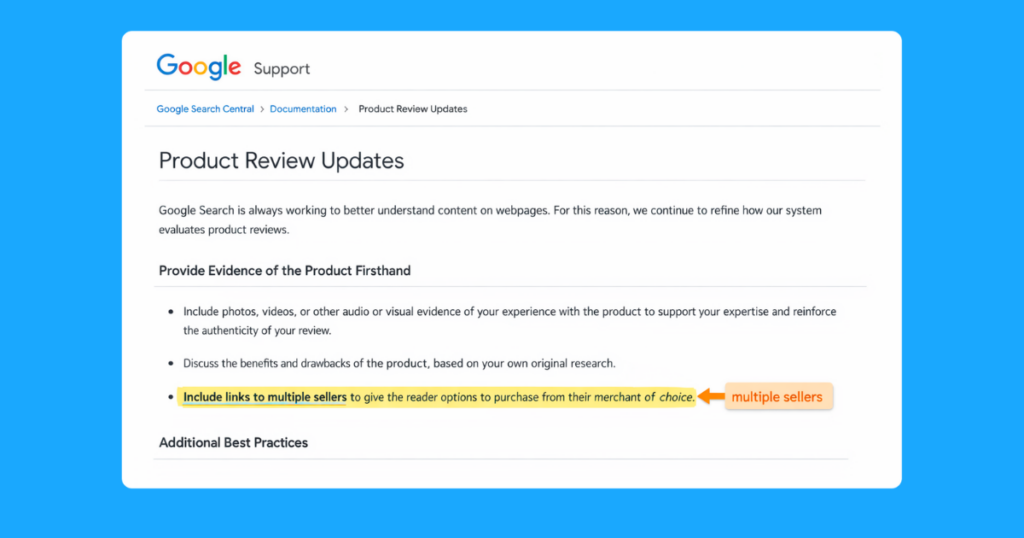
The SEO landscape for affiliate content has shifted significantly over the past few years, and it continues to evolve. Google’s Product Review Update pushed publishers toward more helpful, multi-retailer content, but that’s now table stakes. The more pressing reality is that AI-powered search (Google’s AI Overviews, ChatGPT, Perplexity) is increasingly answering product questions directly, reducing top-of-funnel organic traffic for thin affiliate content. The publishers winning right now aren’t just optimizing for the old Product Review guidelines, but they’re building genuinely useful content that earns clicks even when a summary is already visible in the search result. Multi-retailer linking fits into that: it signals reader-first intent, which matters regardless of whether the traffic comes from traditional search or an AI referral.
Why does Google care about retailer choice? It aligns with their Experience, Expertise, Authoritativeness, Trustworthiness (E-E-A-T) framework. Offering multiple purchase options demonstrates:
- Experience: You understand how real shoppers buy
- Expertise: You know the full market landscape
- Authoritativeness: You’re not just promoting one retailer
- Trustworthiness: You prioritize reader choice over commissions
Major review sites adapted quickly. Visit CNET, Wirecutter, or Tom’s Guide, and you’ll see multiple retailer buttons on every product recommendation. They understand that multi-retailer linking isn’t just about compliance; it’s about matching user intent and maximizing conversions.
For your content structure, this means rethinking how you present purchase options. Instead of scattered Amazon links throughout an article, you need consolidated purchase hubs that offer genuine choice while maintaining a clean user experience.
Market Opportunity: Capturing E-commerce Beyond Amazon
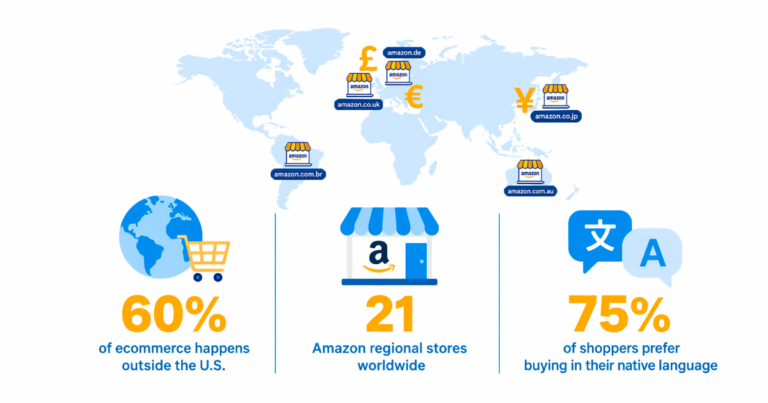
Amazon’s dominance feels absolute until you examine the numbers. Despite their significant presence, substantial e-commerce sales happen elsewhere, at Walmart, Target, Best Buy, Home Depot, and hundreds of other retailers.
Commission rates vary across programs. While Amazon pays percentages depending on category, other programs often offer competitive or higher rates. Target, Walmart, and Best Buy all offer affiliate programs with varying commission structures. When you expand beyond a single retailer, the revenue potential becomes clear.
Shopping behavior varies by product category and demographic. Some consumers might default to Amazon for electronics but prefer Target for home goods. Parents often choose Walmart for bulk purchases. Best Buy’s affiliate commission rates are generally lower than Amazon’s in the electronics category, so it’s not the strongest play purely on rate. The value of including Best Buy links is audience fit, as some shoppers specifically want in-store pickup for expensive electronics or prefer Best Buy’s return policy. Including it as an option costs you nothing and serves those buyers, even if it’s not your highest-converting retailer. By linking only to Amazon, you’re essentially telling these shoppers their preferences don’t matter.
The opportunity extends beyond direct sales. Multi-retailer strategies often boost Amazon commissions, too. When shoppers see multiple options, they feel more confident in their purchase decision. Instead of leaving to comparison shop, they click through and buy, often still choosing Amazon but through your affiliate link.
Core Principles of a High-Earning Amazon Affiliate Content Strategy
Building authority in affiliate content requires mapping E-E-A-T principles to specific content types. Your experience shows through hands-on reviews and detailed comparisons. Expertise emerges from technical specifications and nuanced pros/cons lists. Authority builds through comprehensive guides that cover entire product categories. Trust develops when you acknowledge limitations and provide balanced perspectives.
Keyword research for affiliate content follows a clear hierarchy. Start with commercial intent keywords that include “best,” “review,” or “vs.” These primary keywords anchor your main pages. Layer in secondary keywords focusing on specific features or use cases. Long-tail variations capture high-intent searches like “quiet treadmill for apartment 2026” or “waterproof hiking boots wide feet.”
Copywriting for conversions demands clarity over cleverness. State exactly what the reader gets when they click your link. Avoid superlatives and weasel words that Amazon’s terms prohibit. Instead of “cheapest price anywhere,” write “compare current prices at major retailers.” Skip the hard sell in favor of helpful guidance.
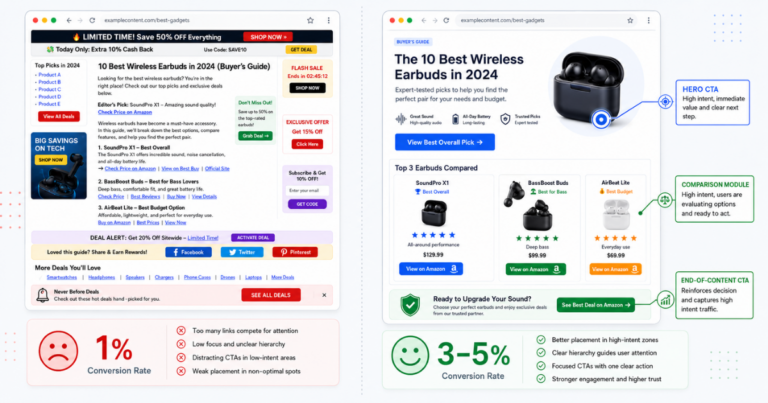
Call-to-action (CTA) placement follows user behavior patterns. Position your first CTA above the fold for readers ready to buy immediately. These “hot” visitors already know what they want, so don’t make them scroll. Place contextual CTAs after key sections where you’ve built value. If you’ve just explained why a feature matters, that’s the moment to offer purchase options.
The most effective CTAs feel like natural next steps rather than interruptions. “Check latest prices and availability” outperforms “BUY NOW!!!” every time. Frame purchases as research completion: “See current offers at Amazon, Walmart, and Target” gives readers control while guiding them toward conversion.
Geniuslink Choice Pages: Turning Every Product Link into a Monetization Hub
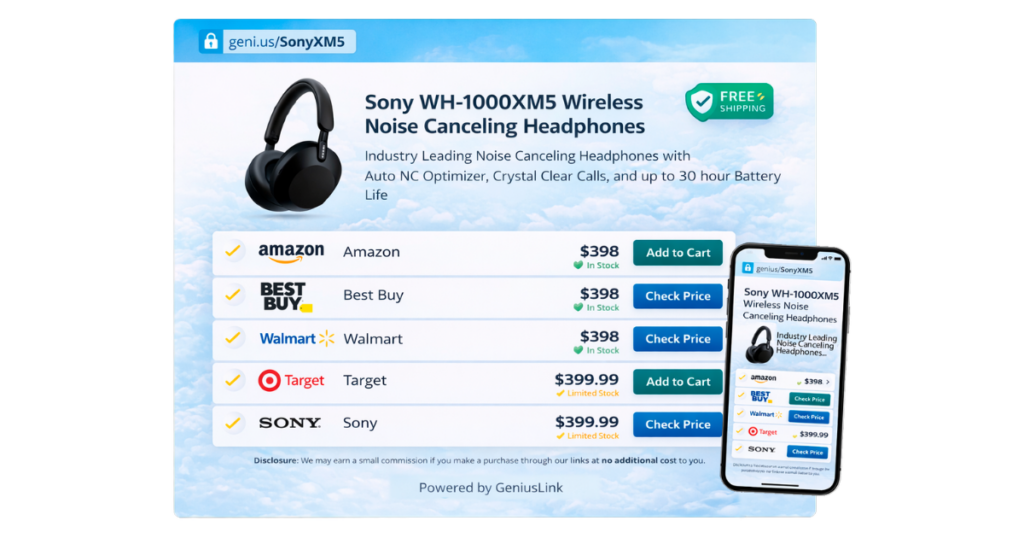
Choice Pages aren’t indexed by Google, so they’re not a direct SEO tool. Their value is what happens after the click: instead of sending a reader to a single retailer and hoping it converts, you give them options, which increases the likelihood that someone buys through one of your affiliate links. The SEO work happens on your article pages (multi-retailer signals, E-E-A-T, structured data) and Choice Pages are the conversion layer that sits behind those pages. Think of it as: good content earns the visit, Choice Pages maximize what you earn from it.
Here’s how it works: Start with any Amazon product link or even just a product name. Geniuslink automatically generates a mobile-optimized landing page displaying that product across all major retailers. The system matches products across stores, pulling in current prices and availability. Your readers see options from Amazon, Walmart, Target, Best Buy, and others, all through your affiliate links.
Setup takes minutes, not hours. After creating your Geniuslink account, paste an Amazon URL into the Choice Page builder. The system identifies the product and finds matches across retailers. You customize the display with your chosen product image, title, and call-to-action buttons. Select which retailers to include based on your audience preferences. Reorder them to highlight your best performers.
Customization options let you match your brand while optimizing conversions. Upload high-quality product images that showcase key features. Craft compelling titles that include primary benefits. Choose button colors that stand out without clashing. Write CTA text that encourages comparison: “Compare Prices,” “Check Availability,” or “View Latest Offers.”
Compliance features automatically handle the technical requirements. Every Choice Page includes Federal Trade Commission (FTC) disclosure language and retailer-specific compliance text. Since Geniuslink hosts these pages, you can share them anywhere, including channels where direct affiliate links violate terms. Email newsletters, social media bios, and YouTube descriptions all become monetization opportunities.
Real results demonstrate the potential. Testing has shown that Choice Pages can significantly increase earnings per click (EPC) compared to direct Amazon links. By giving viewers options instead of forcing a single path, you can capture more purchases and benefit from varying commission rates across retailers.
Hub-and-Spoke Content Architecture: Blueprint & Examples
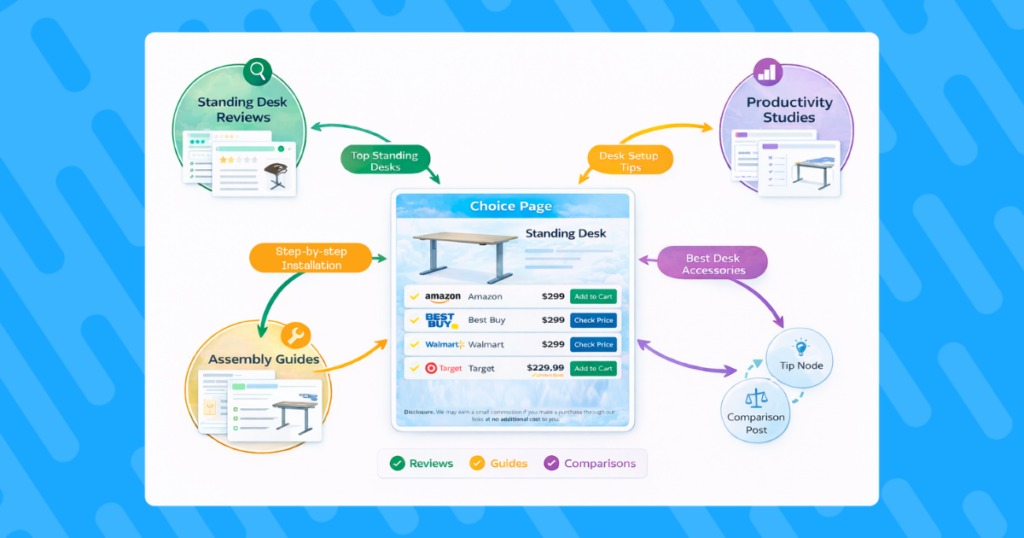
Identifying high-potential product hubs starts with your existing data. Dive into your analytics to find products already generating clicks or sales. Look for seasonal trends and emerging products in your niche. These proven performers become your content hubs, each anchored by a dedicated Choice Page.
For example, imagine you run a home office site and notice that standing desks drive significant traffic. Create a Choice Page for your top-performing model; this becomes your hub. Now build spoke content that feeds this monetization asset: “Standing Desk Assembly Guide,” “Sitting vs Standing: Productivity Study,” “Best Standing Desk Accessories,” and “Standing Desk Height Calculator.”
Each spoke serves a specific purpose in the buyer journey. The assembly guide captures bottom-funnel shoppers concerned about setup difficulty. The productivity study attracts researchers in the awareness stage. The accessories post enables cross-selling opportunities. The calculator provides utility while subtly promoting your recommended desk. Every piece links back to your central Choice Page.
Internal linking strategy amplifies your hub’s authority. Connect related spoke content to build topical clusters. Link from high-traffic posts to newer spokes that need visibility. Use descriptive anchor text that reinforces your target keywords. Create a web of relevant content that points to your monetization hub.
Here’s a visual representation of the architecture: Your Choice Page sits at the center like a spider in its web. Primary spokes (comprehensive reviews, comparison posts) connect directly. Secondary spokes (how-to content, FAQ pages) link to primary spokes and occasionally to the hub. Tertiary content (news updates, seasonal guides) feeds the secondary spokes. Every path eventually leads to your Choice Page.
Scale this model across your top products, and you’ve built a revenue-generating content machine. Each hub becomes stronger as you add spokes. Google recognizes the topical authority. Readers find comprehensive resources. You capture sales at every stage of research.
On-Page SEO & Conversion Tactics for Affiliate Blog Posts
Headline formulas for affiliate content balance search engine optimization (SEO) requirements with click appeal. Lead with the primary benefit, include the year for freshness when appropriate, and specify the audience when relevant. “Best Running Shoes for Flat Feet (2026): Podiatrist-Tested Reviews” beats generic titles every time. Place your primary keyword within the first 60 characters while maintaining natural language.
Product schema markup transforms how your reviews appear in search results. Implement structured review or product data to display star ratings, price ranges, and availability directly on search engine results pages (SERPs). These rich snippets can increase click-through rates. Include pros and cons lists using proper schema; Google often features these in expanded search results.
CTA copywriting requires a delicate balance. Avoid aggressive language that triggers ad blindness. Instead, frame actions as helpful next steps: “Compare current prices at 5+ retailers” or “Check availability and shipping options.” Test button colors that complement your design while standing out; blue typically builds trust, while orange can increase urgency.
Image optimization serves both SEO and conversion goals. Use high-resolution product photos that highlight key features.
Name files descriptively: “herman-miller-aeron-chair-lumbar-support.jpg” rather than “IMG_1234.jpg.” Write alt text that describes the image while naturally including keywords: “Herman Miller Aeron chair showing adjustable lumbar support system.”
Position images strategically to support your conversion path. Place hero images near your first CTA to reinforce the product’s appeal. Use comparison charts and infographics to simplify complex decisions. Include lifestyle shots showing the product in use; these emotional triggers often outperform sterile product photos.
Continuous Optimization: Analytics, EPC Tracking & A/B Testing
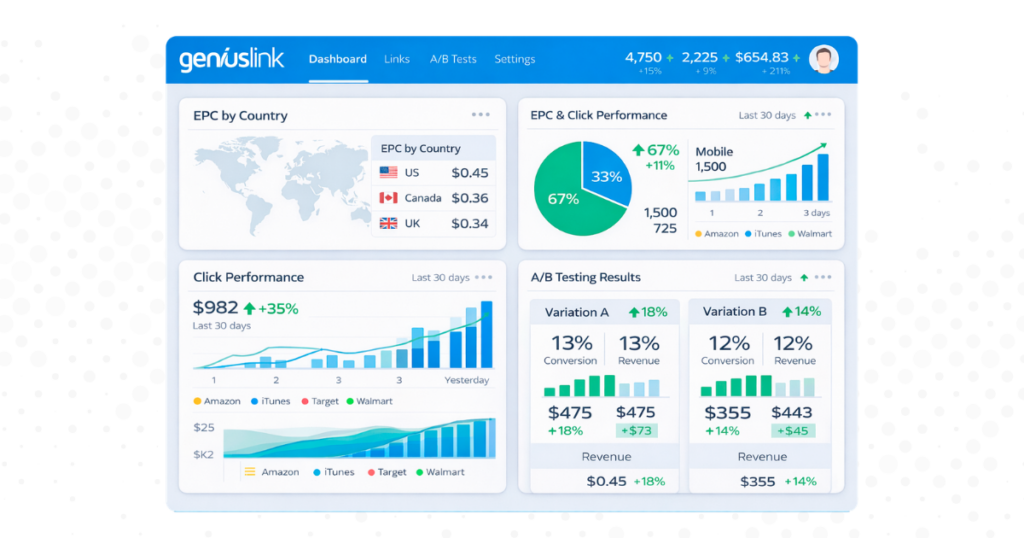
Setting up Geniuslink tracking groups clarifies your data. Organize links by content type, product category, or traffic source. Apply consistent Urchin Tracking Module (UTM) parameters to track performance across your analytics ecosystem. Tag every Choice Page link with meaningful identifiers: product name, content piece, and placement position.
Reading reports effectively means focusing on actionable metrics. Earnings per click (EPC) tells the real story; it accounts for both conversion rate and commission value. A product with lower conversion but higher average order value might outperform a bestseller with smaller commissions. Track click patterns to identify which placements and CTAs drive action.
A/B testing transforms assumptions into data-driven decisions. Start with the retailer order on your Choice Pages. Does Amazon-first outperform Walmart-first? Test over two weeks with significant traffic. Next, experiment with CTA button text. “View All Prices” might beat “Compare Offers” for your audience. Document every test in a spreadsheet with dates, variations, and outcomes.
The optimization cycle never truly ends. Test one element at a time to maintain clear results. Run tests for statistical significance, usually 1,000+ clicks per variation. Implement winners across similar content. Schedule monthly reviews to identify new testing opportunities. Small improvements compound: increasing EPC from $0.12 to $0.15 represents a 25% revenue boost on the same traffic.
Compliance, Disclosures & Trust Signals Under E-E-A-T
FTC disclosure placement follows clear guidelines: conspicuous, clear, and before any affiliate links. “As an Amazon Associate and affiliate for other retailers, I earn from qualifying purchases” covers the basics. Place this above the fold on every page with affiliate links. Don’t hide disclosures in footers or behind “read more” toggles.
Building reviewer expertise requires authentic proof. Create detailed author bios highlighting relevant experience. “Sarah has tested over 50 standing desks during her 10 years as an ergonomics consultant” carries more weight than generic credentials. Link to your LinkedIn profile or professional certifications. Include photos of you actually using the products.
Technical trust signals support your content’s credibility. Implement HyperText Transfer Protocol Secure (HTTPS) across your entire site; Google considers this essential. Add author schema markup to connect your content to your bio. Include publication and update dates on every post. Link to authoritative sources when citing statistics or studies. These signals reinforce your E-E-A-T positioning.
Step-by-Step Implementation Checklist
Getting started with Geniuslink takes less than an hour. First, create your account and connect your Amazon Associates ID. Next, find your top-performing product and create your first Choice Page. Customize the appearance to match your brand. Generate your short link and replace existing Amazon links in your highest-traffic content.
Week one focuses on retrofitting existing content. Identify your 10 best-performing posts by traffic and conversion. Create Choice Pages for the primary products in each. Update internal links to point to these new hubs. Monitor early performance to establish baselines.
Month one expands the strategy. Build Choice Pages for your top 25-30 products. Create new spoke content for high-EPC products. Set up tracking groups to segment performance. Implement your first A/B test on retailer order or CTA placement.
Establish a monthly analytics review routine. First Monday: Pull EPC reports for all Choice Pages. Identify winners and underperformers. Second Monday: Analyze traffic patterns and user behavior. Third Monday: Review A/B test results and implement changes. Fourth Monday: Plan next month’s content calendar based on performance data.
Common Pitfalls & How to Avoid Them
Over-monetization damages trust faster than anything else. Resist the temptation to stuff every paragraph with affiliate links. One Choice Page link per 300-400 words maintains balance. Focus on helping readers decide rather than pushing them to buy. Quality content with moderate monetization outperforms aggressive linking every time.
Neglecting link health monitoring leads to revenue leakage. Products go out of stock. Prices change. Retailers discontinue items. Geniuslink’s automatic monitoring flags these issues, but you must act on the alerts. Schedule weekly link health checks. Update or replace dead products immediately.
Mobile user experience often gets overlooked. Test every Choice Page on actual mobile devices, not just browser emulators. Ensure buttons are thumb-friendly. Verify that product images load quickly. Check that disclosure text remains visible. Remember: a majority of affiliate clicks now come from mobile devices.
Future Trends: AI, Video, and Emerging Retailers
Artificial intelligence (AI) generated content outlines accelerate production when combined with human expertise. Use AI to research product specifications and generate comparison tables. Then add your authentic experience and testing insights. The combination scales content creation while maintaining the personal touch that Google rewards.
Shoppable video content represents the next frontier. Platforms like YouTube Shopping and TikTok Shop enable direct product integration. Choice Pages work perfectly here; one link in your description covers all retailers. Interactive video overlays pointing to Choice Pages combine engagement with monetization.
Emerging retailer programs offer early-mover advantages. TikTok Shop affiliates report strong conversion rates with younger demographics. Specialty retailers in niches like outdoor gear or crafting often pay competitive commissions. Adding these to your Choice Pages diversifies revenue while serving specific audience segments.
Next Steps
The multi-retailer imperative isn’t just about compliance or best practices; it’s about capturing the full revenue potential of your content. When you limit readers to a single retailer, you’re leaving money on the table and frustrating shoppers who have preferences. Geniuslink Choice Pages solve this elegantly while multiplying your earnings from qualifying purchases.
Start implementing this playbook today. Create your first Choice Page for your best-performing product. Test it against your existing Amazon links. Track the EPC improvement. Then expand systematically across your content. The compound effect of these optimizations will transform your affiliate revenue.Ready to maximize your affiliate earnings across all major retailers? Start your free Geniuslink trial today and discover how Choice Pages can boost your revenue while simplifying link management.
Author
Author