

Amazon Affiliate Disclosure: Transparency Is Your Conversion Engine
Let’s cut straight to it: Amazon affiliate disclosure isn’t optional.
Both the Federal Trade Commission and Amazon require clear, conspicuous statements whenever you’re earning commissions, in order to comply with legal requirements.
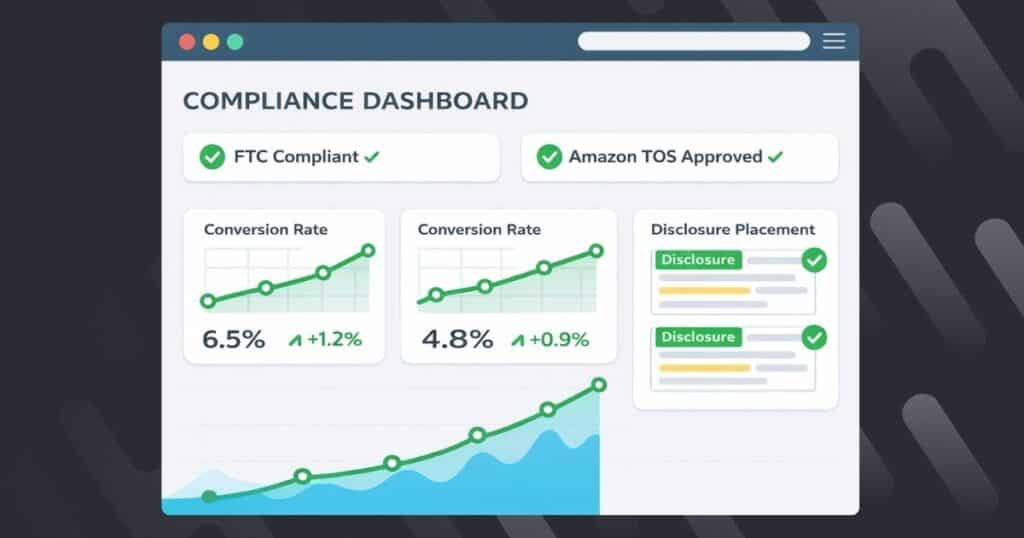
The Amazon Associates Program, Amazon’s official affiliate marketing initiative, specifically requires these disclosures. But here’s what most guides miss: proper disclosure actually improves conversions.
Why? Because transparency builds trust. When readers know you’re being upfront about affiliate relationships, they’re more likely to click through and buy. Clear disclosures also foster trust and credibility with customers, helping to build positive relationships and ease any concerns.
The trick is implementing FTC affiliate rules and Amazon’s requirements without turning your content into a legal document.
This guide shows you exactly how to create clear, conspicuous disclosure that satisfies regulators while keeping your content clean and reader-friendly. You’ll learn the specific Amazon Associate statement requirements, see real examples that work, and discover how Geniuslink’s tools can automate affiliate marketing compliance without the clutter.
Affiliate Links Program 101: Why Disclosure Matters as an Amazon Associate
The Legal Perspective
First, the non-negotiables: As of January 2025, the FTC can fine you up to $53,088 per violation for missing or inadequate disclosures.
The Federal Trade Commission, as the primary regulatory body, enforces these requirements under applicable law and the authority of relevant governmental authorities.
Amazon? They’ll simply terminate your account. No warnings, no second chances. In cases of disclosure violations, direct law enforcement agencies may also become involved to enforce compliance. That’s why you need to disclose affiliate links properly from day one.
The Business Perspective
According to market research, 94% of consumers report being more likely to be loyal to a brand when it commits to providing complete transparency (Label Insight, as cited by Forbes). Working in tandem with good product review procedures, this commitment to openness will make a huge difference in building trust and driving long-term customer value
When you’re upfront about affiliate relationships, you’re not just following rules; you’re building a sustainable business that readers trust.
Clear disclosures are essential when earning money through affiliate marketing, as they ensure your audience understands your relationship with recommended products.
Having a clear disclosure policy also helps maintain transparency and business credibility.
The User-Experience Perspective
Ethical affiliate marketing isn’t just the right thing to do; it’s good for business. The key is making disclosures obvious without being obnoxious.
Decoding Amazon Associate Program Rules: FTC vs. Global Standards
What the FTC Expects
The FTC endorsement guidelines are actually pretty straightforward. Any material connection (like earning commissions) must be disclosed “clearly and conspicuously.” This means:
- Using plain language everyone understands (no legalese).
- Placing disclosures where they can’t be missed.
- Making them stand out visually from surrounding content.
- Repeating them as needed in long content.
⚠️ Crucial Note for Global Publishers:
It is vital to remember that FTC coverage does not always meet international standards. If you have an international audience, you must research and comply with the specific disclosure laws of other regions (such as the UK, EU, or Canada) in addition to the FTC’s requirements.
Compliance and Best Practices
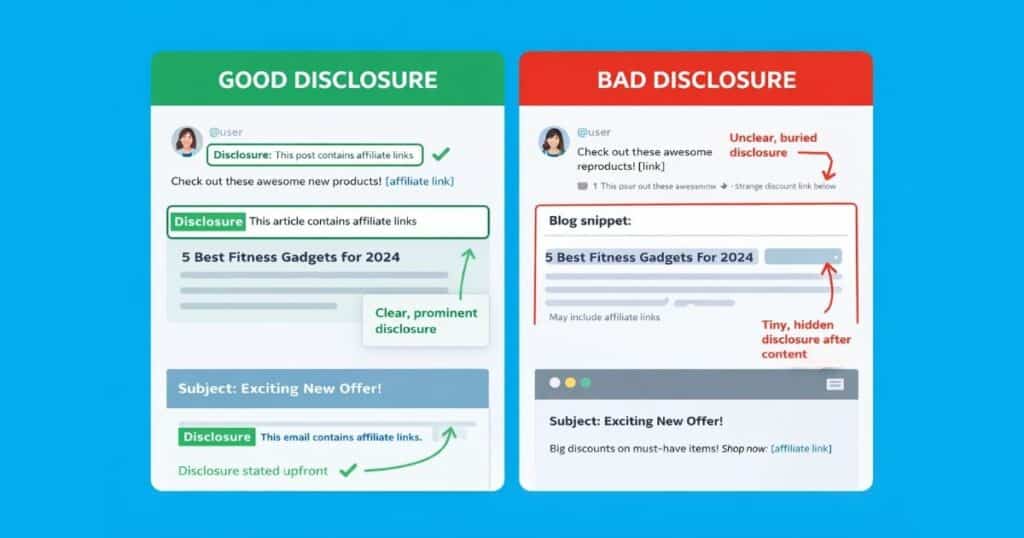
It’s important to include a clear disclosure and follow the FTC’s guidelines for affiliate link disclosure. Proper affiliate link disclosure ensures you comply with both Amazon’s policies and FTC guidelines, helping you avoid legal issues and maintain trust with your audience.
You need a short disclosure that is clear and easily understood, using clear terms like the ones specified by Amazon and the FTC: #ad, #sponsored, or “Paid link.”
What Amazon Requires
The Amazon Associates Operating Agreement adds its own layer. The Amazon affiliate program, also known as the Amazon Associates Program, is an affiliate marketing initiative that allows website owners and bloggers to earn commissions by promoting Amazon products through affiliate links. You must include this exact statement on your site near where you are sharing affiliate links: “As an Amazon Associate, I earn from qualifying purchases.”
In addition to this required statement, you must ensure your site includes clear Amazon affiliate disclosures and Amazon affiliate link disclosures. It is important to use an Amazon disclosure statement or a substantially similar statement as your first disclaimer to comply with both Amazon’s and the FTC’s guidelines.
What to Avoid
- Implying Amazon endorses your content
- Hiding disclosures in tiny or low-contrast text
- Using links that obscure the Amazon destination
- Placing affiliate links in certain channels without proper disclosure
Where the Two Overlap (and Clash)
Both require transparency, but their approaches differ. The FTC focuses on protecting consumers with paid link requirements that are impossible to miss. Amazon cares about both the customer being made aware and ensuring the Amazon brand and business is compliant and protected.
The solution? Follow the strictest interpretation of both. Use Amazon’s exact wording for your site-wide notice, and add clear FTC-compliant disclosures near each link.
This dual approach keeps everyone happy. Remember, you must comply with all legal requirements and applicable rules, ensuring that neither your participation in the Associate’s Program nor the creation, maintenance, or operation of your site violates any applicable laws.
Self-Regulatory Rules: 7 Must-Follow Guidelines for Disclosures
#1 Be Upfront and Specific
Here are some Amazon affiliate disclosure examples that clearly demonstrate compliance with Amazon and FTC requirements. Clear affiliate disclosure examples always use everyday language that your grandmother would understand.
#2 Use Plain, Short Language
Keep it simple. “Paid link,” “Affiliate link,” or “I earn from qualifying purchases” all work. The key is using plain-language disclosure that doesn’t require a law degree to decode. A clear disclosure statement is essential for compliance with FTC and Amazon guidelines and should be easy for your audience to understand.
#3 Position Disclosure Above the Fold
Prominent placement means readers see your disclosure before they encounter affiliate links. For blog posts, this means at the beginning, not buried after three paragraphs.
#4 Repeat in Long-Form Content
Got a 3,000-word guide? One disclosure at the top isn’t enough. Repeat disclosures before major sections containing affiliate links. Think of it like this: if someone jumps to a specific section via the table of contents, they should still see a disclosure.
#5 Adapt for Each Platform
Platform-specific rules matter. Instagram Stories need on-screen text or verbal disclosure. YouTube requires both description and verbal mentions. Pinterest needs disclosure on the image itself, not just in descriptions. Each platform has quirks; you need to learn them.
#6 Never Imply Amazon Endorsement
This trips up many affiliates. Never write “Amazon recommends” or “Amazon’s favorite.” You’re an independent affiliate, not an Amazon employee. Keep that distinction crystal clear in all your content.
#7 Keep Hashtags Unambiguous
Stick to hashtags everyone understands: #ad, #affiliate, #sponsored. Skip the cutesy abbreviations. When in doubt, spell it out. Your creativity should go into content, not into hiding disclosures.
Common Disclosure Mistakes in Rules Governing Communications
Mistake #1: Burying the Statement
The classic affiliate disclosure mistakes involve putting a tiny disclaimer at the very bottom of a 5,000-word post. Both the FTC and Amazon specifically call this out as non-compliant. Your disclosure needs to be impossible to miss, not hidden like an Easter egg.
Mistake #2: Relying on “See More” Folds
Social platforms often truncate captions. If your disclosure sits after the “See More” break, most users won’t see it. That’s why hidden disclosures in truncated content can trigger penalties. Always put disclosures in the first line or two.
Mistake #3: Cryptic Hashtags (#sp, #spon)
Using ambiguous hashtags might save characters, but they don’t save you from fines. The FTC has been crystal clear: if average consumers don’t understand your disclosure, it doesn’t count. Stick to obvious terms.
Mistake #4: Skipping Site-Wide Notice
Many affiliates add disclosures to individual posts but forget the site-wide Amazon statement. This leaves you vulnerable to account termination. Even if every post is perfectly disclosed, a missing site-wide notice violates Amazon’s terms. Don’t let a buried affiliate link or missing footer statement trigger FTC penalties or Amazon account suspension.
Geniuslink to the Rescue: Automated, Compliant Choice Pages
How Choice Pages Work
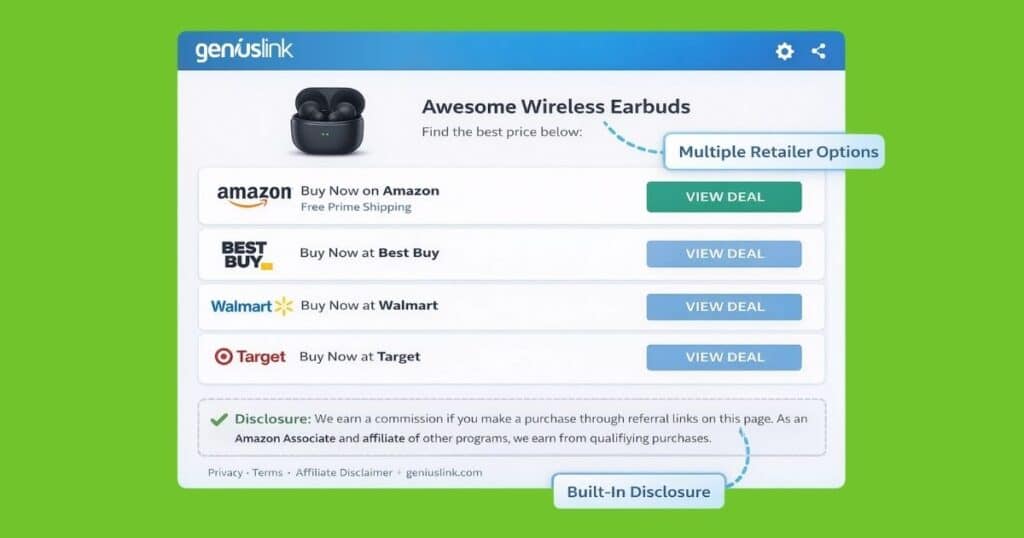
Geniuslink Choice Pages elegantly solve the disclosure clutter problem. Instead of cramming disclosures into every caption and post, you create one link, and we automatically create a mini landing page that includes all required statements.
When users click your link, they see a clean page (with multiple retailer options if you choose) and all the necessary disclosures built right in.
Built-In Compliance Features
Here’s the magic: every Choice Page includes automatic affiliate disclosure by default. The disclosure appears immediately beneath the Amazon button to proceed. You don’t even have to set it up; it’s included by default, so every choice page link you share carries compliant disclosures without cluttering your content.
Revenue & CTR Lift: Real Data
The best part? Choice Pages don’t just ensure compliance; they increase affiliate revenue. Geniuslink’s data shows earnings per click more than doubled when affiliates switched from direct Amazon links to Choice Pages.
Why? Because 78% of shoppers compare prices across retailers before buying. Multi-retailer link options satisfy that behavior.
When to Use Choice Pages vs. Direct Links
Use Choice Pages when:
- You’re limited to one link (Instagram bio, email signatures)
- You want to keep social captions clean
- You’re promoting in print or PDFs
- You want to offer multiple retailer options
Stick with direct links when you’re discussing one specific product in detail and have room for proper inline disclosures. The link management tool handles both scenarios perfectly.
Step-by-Step: Adding Disclosures to Every Channel
Blogs & Websites
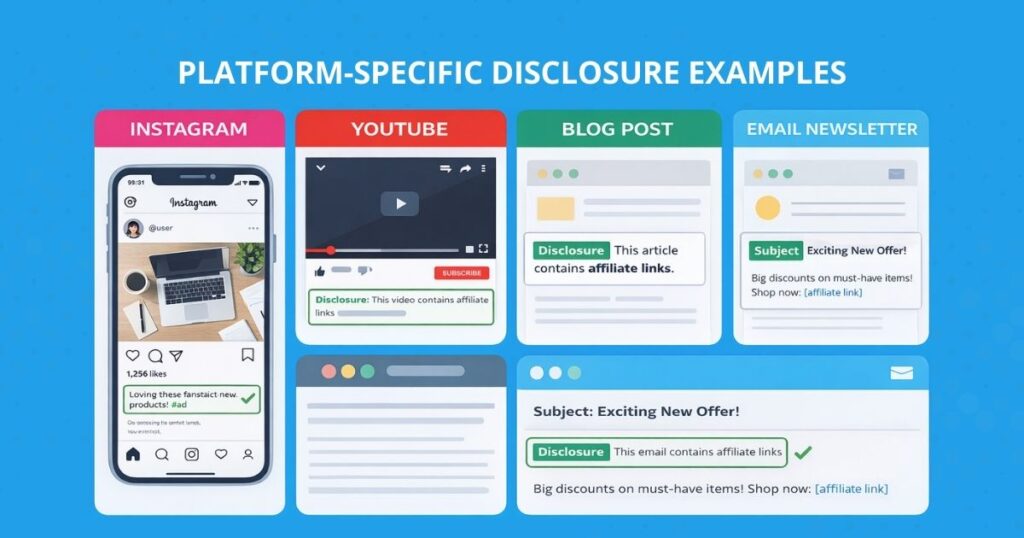
For blog affiliate disclosure placement:
- Add Amazon’s statement to your footer or About page
- Include a disclosure box at the beginning of posts with affiliate links; make sure to include your website name in the disclosure for transparency
- Use inline disclosures like “( affiliate link)” next to each affiliate link
- For long posts, repeat the disclosure before new sections with links
Instagram, TikTok, Facebook & Pinterest
Social media affiliate disclosure requires platform-specific approaches:
- Instagram: Use #ad in the first line of captions, add “Paid partnership” tag
- Facebook: Use #ad in the first line of captions
- TikTok: Include #ad visibly on screen, mention verbally if speaking
- Pinterest: Overlay disclosure text on images, not just in descriptions
- All platforms: Put disclosure before any “See More” break
YouTube & Podcasts
YouTube affiliate disclosure needs triple coverage:
- Verbal mention within the first 30 seconds
- On-screen text disclosure during product mentions
- Written disclosure at the top of descriptions
For podcasts, state your affiliate relationship clearly in the intro and before mentioning specific products.
Email Newsletters
Email affiliate links require extra care. Amazon only allows them to opt-in subscribers. Best practices:
- Include disclosure in email header or early in content
- Mark affiliate links clearly inline
- Consider using Choice Pages to simplify
- Always comply with CAN-SPAM and PECR requirements
Printed & Offline Media
This is a crucial point regarding Amazon Associates compliance, particularly the distinction between what the policy says and what a solution like Geniuslink provides.
Here is the reworked content that removes the incorrect term “raw affiliate links” and uses the specific language from the Amazon Associates Operating Agreement, while incorporating the feedback about Geniuslink’s compliance solution.
Reworked Content
Offline Compliance: Amazon’s Strict Rules for Print and PDF
This surprises many affiliates: Amazon strictly prohibits the use of a Special Link (the standard affiliate URL provided by Amazon) in any offline manner. As stated in the Operating Agreement:
“You will not engage in any Promotional Activities in any offline manner, including by using… any Special Link in connection with any printed material, ebook, mailing, or any oral solicitation.”
This means that direct Amazon affiliate links are not compliant for physical books, PDFs, printed flyers, or QR codes. The approved workaround is to use a Geniuslink Choice Page URL. Since a Choice Page is a compliant, publicly available webpage with built-in disclosures, it allows a creator to use the actual Amazon link while sharing a simple, clean link in any offline material.
Creating Your Disclosure Template Library
Site-Wide Footer Template
Keep this in your footer or About page: “As an Amazon Associate, I earn from qualifying purchases. This site contains affiliate links. I may receive a commission if you purchase through my links, at no extra cost to you.”
Blog Post Snippet Template
For post beginnings: “This post contains affiliate links. If you click through and make a purchase, I may earn a commission at no additional cost to you. Thank you for supporting [Your Site Name]!”
Social Caption Template
For social posts: “Affiliate links below. I earn from purchases (at no extra cost to you!) #ad”
Video/Podcast Script Template
For verbal disclosure: “Quick note: some links in today’s episode/video description are affiliate links. If you purchase through them, I earn a small commission that helps support the channel, at no extra cost to you.”
Save these affiliate disclosure templates where your team can access them. Consistent wording across all content helps standardize compliance, speeds up your content workflow, and maintains brand voice consistency. Update them quarterly to stay current with any platform changes.
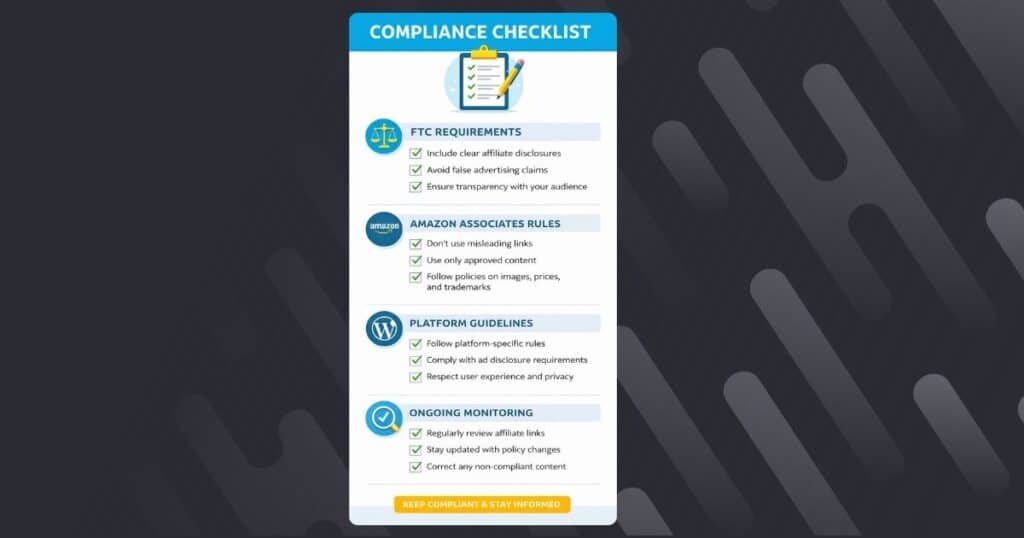
Monitoring & Updating for Ongoing Compliance
Quarterly Disclosure Audits
Set calendar reminders to audit affiliate links every three months. Check that:
- All posts with affiliate links have proper disclosures
- Your site-wide Amazon statement is still visible
- Social media bios include required language
- Disclosure placement still meets visibility requirements
Using Geniuslink Analytics
Link health checks go beyond compliance. Geniuslink automatically monitors whether products are in stock and links are working. Dead links hurt user experience and can trigger compliance reviews. The platform alerts you to issues before they become problems.
Staying Ahead of Policy Updates
Both FTC updates and Amazon policy changes can happen without fanfare. Subscribe to:
- Amazon Associates newsletter
- FTC business guidance updates
- Geniuslink blog and Newsletter for affiliate compliance news
When changes happen, update your templates immediately. Being proactive with your compliance checklist beats scrambling after a warning.
FAQ: Quick Answers to 10 Common Amazon Affiliate Disclosure Questions
1. What are the industry standards do I have to disclose on every link?
Yes. Every affiliate link needs a clear disclosure nearby. This isn’t just an Amazon affiliate FAQ favorite; it’s a legal requirement for data protection and other important consumer program content rules. Using Choice Pages can consolidate this requirement into one compliant landing page.
2. Is “As an Amazon Associate…” enough?
For your site-wide notice, yes. But individual links need additional disclosure, such as “(paid link)” or “#ad,” to satisfy both Amazon and FTC requirements. The site statement alone isn’t sufficient for legal affiliate marketing.
3. Where should I put the disclosure in a blog post?
Best practice for #ad placement: Include a disclosure box at the very beginning of any post containing affiliate links, then use inline markers like “(affiliate link)” next to each URL. For longer posts, repeat the disclosure before new sections with links.
4. Can I shorten Amazon links for Social Media Posts and similar content?
Yes, but with conditions. Amazon allows URL shorteners as long as the destination remains clear. Geniuslink handles this perfectly, and is Guaranteed Amazon Safe. You can create branded short links like “yoursite.com/product-name” that maintain transparency while looking professional.
5. Do I need to disclose in email newsletters?
Absolutely. Email requires the same disclosure questions to be answered as any other medium. Include a brief statement at the beginning of emails containing affiliate links. Remember: Amazon only permits affiliate links in emails to opted-in subscribers.
6. What about PDFs or print guides?
Amazon prohibits direct affiliate links in printed materials. The solution? Use a Geniuslink Choice Page URL instead. Since it’s a web page with built-in disclosures, it’s compliant for offline use while still tracking your commissions.
7. How long should the disclosure be?
The key isn’t length but clarity. Short vs long disclosure doesn’t matter if readers understand your relationship. “Paid link” works. “I earn from purchases” works. A paragraph of legal jargon doesn’t work better; it might actually hurt comprehension.
8. Are emoji or icons acceptable?
Text disclosures are safest. While some use money bag emojis or icons, these can be misinterpreted or not displayed properly across devices. Stick to clear text that works everywhere.
9. Do negative reviews need disclosure?
Yes! Your opinion doesn’t change the disclosure requirement. Whether you love or hate a product, if you’re using affiliate links, you must disclose. Transparency applies to all content, not just positive reviews.
10. What happens if I forget?
Best case: nothing. Realistic case: warnings from Amazon or the FTC. Worst case: account termination or fines up to $53,088 per violation. Set up systems to ensure you never forget; the stakes are too high for “oops.”
Conclusion & Next Steps
Your Action Plan in 30 Seconds
Here’s your affiliate compliance recap in actionable steps:
- Add Amazon’s required statement to your site footer today
- Create disclosure templates for each content type
- Audit existing content for missing disclosures
- Set up Geniuslink Choice Pages for cleaner implementation
- Schedule quarterly compliance reviews
Stay Transparent, Earn More
Remember: transparent marketing isn’t just about following rules. It’s about building trust that converts. When readers know you’re being honest about affiliate relationships, they’re more likely to click and buy. Proper disclosure is your competitive advantage, not a burden.
What are the next steps for affiliates who want to optimize revenue while staying compliant? Implement these strategies systematically. Start with your highest-traffic content, then work through your catalog. Use Geniuslink’s tools to automate compliance wherever possible.