
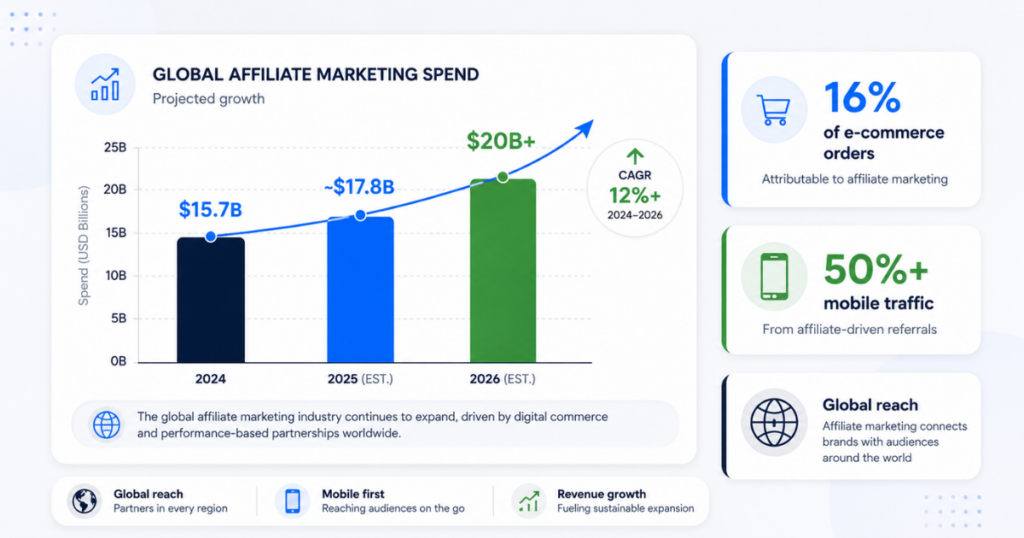
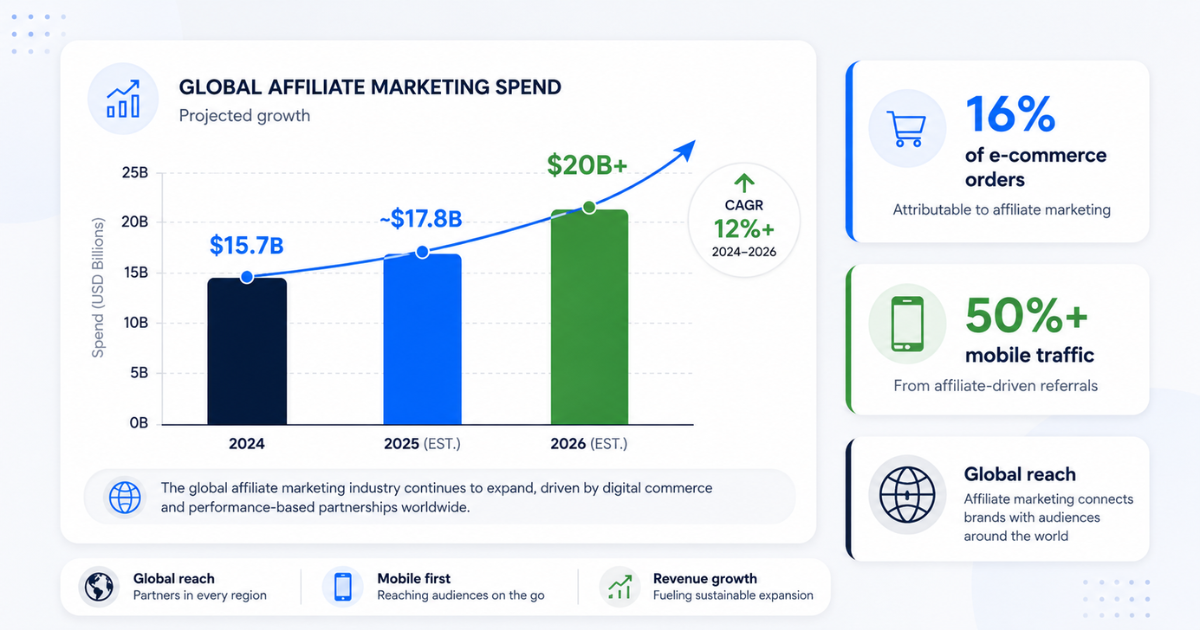
The affiliate marketing industry continues to grow across every major metric. Forrester’s 2026 Forecast projects $19.4 billion in global affiliate spend, and Cognitive Market Research valued the global affiliate marketing industry at $18.5 billion in 2024, with projections reaching $31.7 billion by 2031. In the United States specifically, affiliate marketing spend exceeded $10 billion for the first time in 2024, according to eMarketer.
These numbers reflect a channel that has moved from supplementary tactic to core revenue strategy for both publishers and brands. Affiliates now drive ~16% of global online orders, and over 84% of brands run formal affiliate programs. For publishers operating in this environment, the fundamental optimization questions are concrete: are you capturing commissions from mobile visitors, international audiences, and shoppers who prefer retailers other than Amazon? This analysis breaks down the key data points and what each means for a practical affiliate strategy.
The 2026 Affiliate Marketing Landscape: Market Size and Spend
The industry’s growth trajectory is sustained rather than speculative. Cognitive Market Research projects a compound annual growth rate of approximately 8% through 2031, driven by increased e-commerce adoption, rising digital ad budgets, and improved attribution technology that makes performance-based partnerships more measurable and attractive to brands.
Regional distribution shows North America holding approximately 40% of the global affiliate market share, with Europe accounting for roughly 30% and Asia-Pacific at approximately 23%, though APAC is the fastest-growing region year over year. This geographic expansion creates direct opportunity for publishers who capture international traffic across multiple markets rather than optimizing exclusively for domestic audiences.
On the publisher side, approximately 84% of web publishers now participate in affiliate marketing in some form, whether through dedicated review content, social media influence, or email promotion. Competition for keyword rankings and audience attention has intensified accordingly. Publishers who optimize their link infrastructure to capture more value from existing traffic gain an efficiency advantage over those focused solely on traffic volume growth.
Affiliate Share of E-commerce Sales
Affiliates drive about 16% of all online orders globally, representing roughly one in six e-commerce transactions. This share varies significantly by category. Software and digital services commonly see 20-30% of sales through affiliates. Physical product categories typically run 10-20%, with travel and financial services spiking higher during peak research and purchase windows.
This category-level variation matters strategically. A publisher in a vertical where affiliates drive 25% of industry sales has a larger addressable market than one in a category where affiliate share is 5%. Understanding your category’s typical affiliate share helps calibrate realistic growth expectations and identify whether geographic expansion or program diversification is likely to produce the most incremental revenue.
ROI Benchmarks and Cost-to-Return Ratios
Industry data shows affiliates generate between $6.50 and $15 in revenue for every dollar spent, a range that reflects the substantial variation in program maturity, commission structure, and publisher quality. For context, a 3-4x return is considered strong in most paid media channels.
These ranges vary by sector. SaaS affiliates often achieve the highest returns due to recurring revenue and high customer lifetime values. Fashion and beauty typically see returns in the mid-range, balancing moderate commissions with high purchase frequency. Electronics and appliances may show lower multiples but generate substantial absolute revenue due to high average order values.
Commission rates correlate directly with the category economics. Digital products and services average 20-40%, while physical goods typically range from 3-10% depending on the retailer and category. Seller networks within Amazon’s ecosystem, accessible through Geniuslink’s seller network integrations, offer rates averaging approximately 20% with a 14-day attribution window, according to Levanta’s published data, substantially higher than standard Amazon Associates category rates of 1-10%.
Mobile: The Majority of Affiliate Traffic
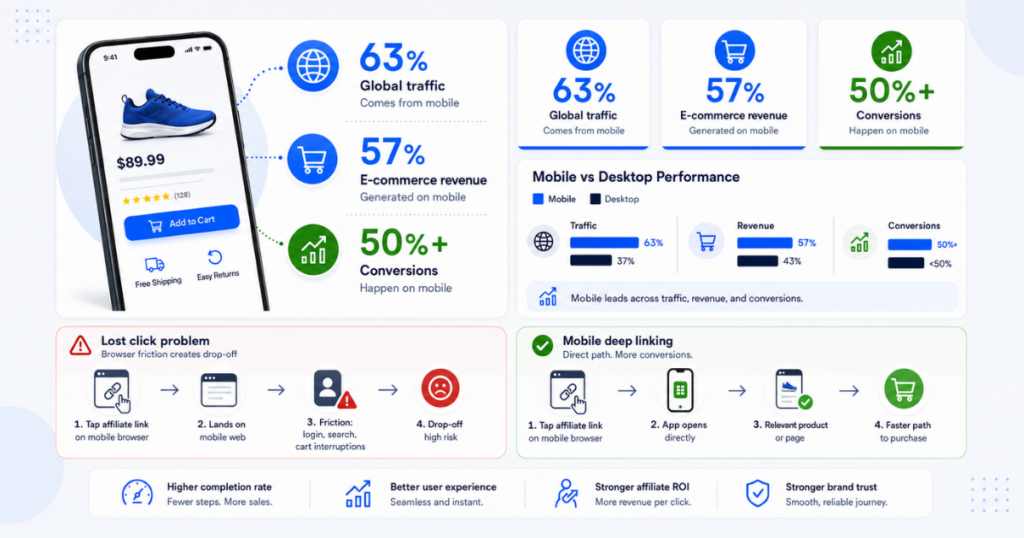
Mobile now accounts for approximately 50% of affiliate-referred traffic, and mobile devices drive more than 57% of affiliate-driven purchases. The gap between mobile’s share of traffic and its historical share of conversions has been closing, driven in part by improvements in mobile checkout experiences and the growing use of native retailer apps for purchase completion.
The technical friction that has historically suppressed mobile conversion rates is well documented. When a mobile visitor taps a standard Amazon affiliate link, a browser opens rather than the Amazon app. The visitor hits a login prompt, navigates a less streamlined checkout, and a meaningful share exits before completing the purchase. Your commission disappears at the authentication screen, even though the visitor intended to make a purchase.
Geniuslink’s mobile deep linking routes mobile visitors directly into the Amazon app when installed, eliminating this friction point. Geniuslink’s testing found up to 4.8x higher earnings and 7.9x more purchases from mobile traffic when deep linking was turned on, compared to standard browser-only links. For any publisher where mobile represents a substantial share of total traffic, this is the highest-impact single optimization available.
Video content’s role in mobile affiliate discovery continues to grow. Video now comprises a substantial share of mobile data consumption, and short-form platforms have trained consumers to discover and purchase products through mobile video content. Affiliates creating content for TikTok, YouTube Shorts, and Instagram Reels need link infrastructure that functions correctly from within platform in-app browsers, which have their own handling behaviors separate from native mobile browsers.
Global Expansion and the Localization Opportunity
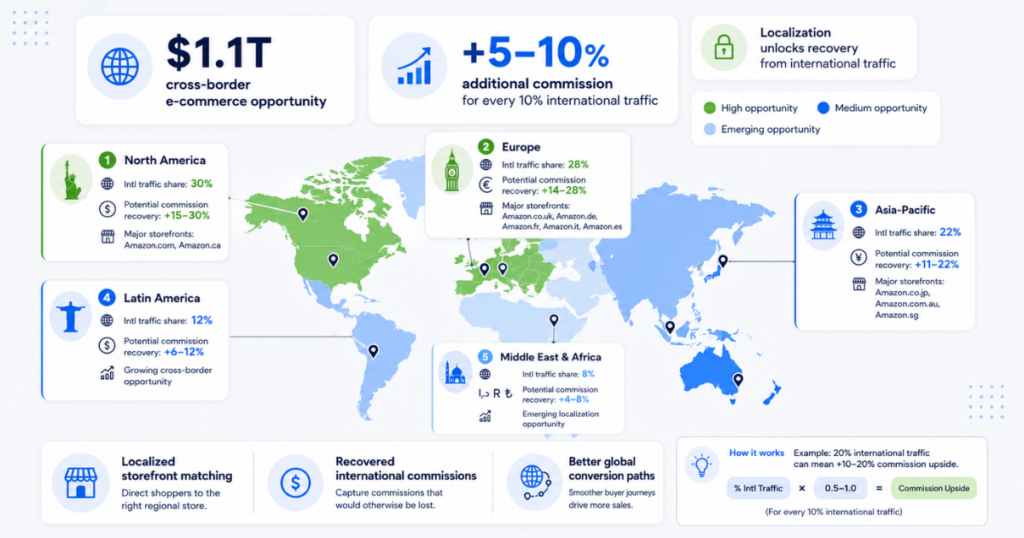
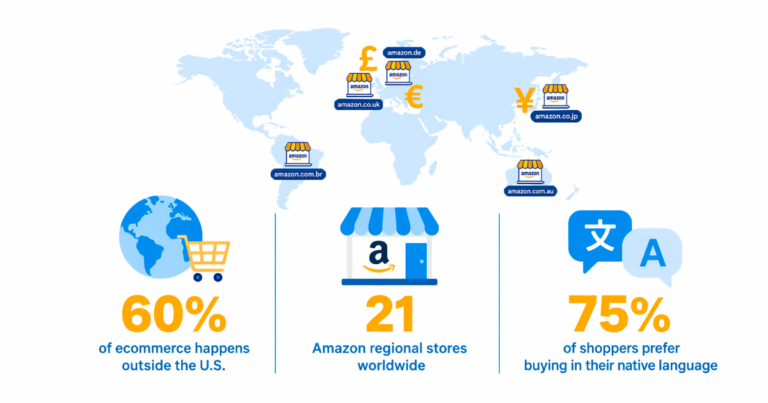
Research shows 59% of global shoppers buy from retailers outside their home country, and 62% expect local-currency pricing when shopping internationally. These behaviors translate directly into lost commissions for any publisher routing all traffic to a single regional storefront.
The mechanics are straightforward. A UK visitor who clicks your Amazon.com affiliate link lands on a US storefront with dollar pricing, limited Prime benefits, and different inventory. Most leave without purchasing. Even those who then navigate manually to Amazon.co.uk do not generate a commission for you because your US tracking ID does not follow them to the regional storefront. Amazon operates 19 or more affiliate-supported storefronts globally, and each requires its own program enrollment and tracking ID.
Geniuslink’s analysis found that enabling localization contributes roughly 5% more to total affiliate revenue for each 10-point increase in a publisher’s international audience share. A publisher with 40% international visitors can recover approximately 20% more total revenue from existing traffic by routing those clicks to the correct regional storefront. Geniuslink’s localization tools handle this automatically once regional tracking IDs are added to the dashboard.
Shopper Behavior: Comparison Shopping and Multi-Retailer Journeys
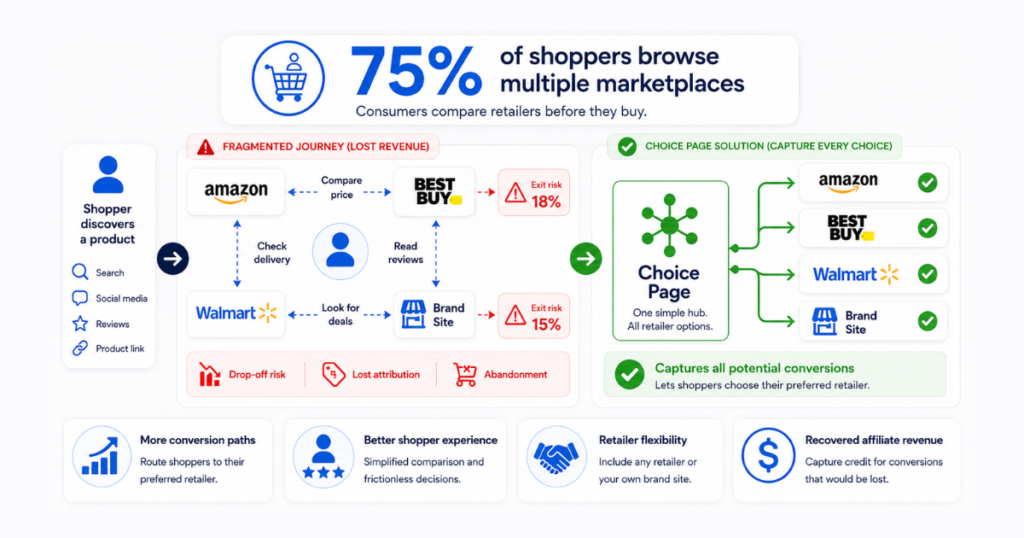
Modern consumers research purchases across multiple retailers before committing. Mobile devices account for more than 57% of affiliate-driven purchases, and those mobile sessions increasingly span multiple retailer sites and apps as shoppers check prices, availability, and shipping options before deciding where to buy. The purchase journey is non-linear by design for a meaningful share of buyers.
This behavior creates a structural problem for single-retailer affiliate links. A visitor who clicks your Amazon link but ultimately purchases at Walmart earns you nothing from the Walmart transaction, even if your content directly influenced the purchase decision. The sale occurred, the commission did not.
Geniuslink’s Choice Pages address this by consolidating several retailer options for the same product into a single, clean, mobile-optimized page behind a single link. The visitor selects their preferred store; your commission attribution is assigned to the retailer that completes the sale. In 11 A/B tests, Geniuslink documented a 2.2x average earnings-per-click gain when publishers moved away from direct single-retailer links to Choice Pages, with individual results reaching 4.2x. Geniuslink’s published case study of YouTuber Armando Ferreira (Mondo Bytes) documented a 2.6x income lift after he made Choice Pages his primary linking approach.
Multi-retailer linking also provides a practical hedge against stock availability issues. A product that goes out of stock on Amazon while remaining available at Best Buy costs you no commission when visitors can see and select the in-stock alternative on the same Choice Page.
Vertical Highlights and High-Growth Niches
SaaS and digital services lead in commission rate and earning potential per referral. With recurring revenue models and commissions that can extend beyond the initial sale, SaaS affiliates can earn 30-50% commissions with some programs paying recurring commissions for the customer’s lifetime. B2B SaaS shows particular strength as businesses continue investing in cloud-based tooling.
Fintech and financial services offer some of the highest absolute per-conversion values, from flat fees for account openings to percentage-based commissions on investment platforms. Regulatory requirements add complexity but also reduce competition by creating barriers to entry for less established publishers.
Travel rebounded strongly from its pandemic-era lows, with high transaction values compensating for modest percentage commission rates. Travel insurance, experiences, and vacation rentals offer higher margins than flights and hotels. Seasonal patterns are pronounced, making it important for the content calendar to align with peak booking windows.
Health and wellness benefits from consistent consumer spending on supplements, fitness equipment, and mental health applications. Subscription models are common, creating recurring commission opportunities from single referrals.
Emerging Technologies Shaping the Landscape
AI tools are now standard in affiliate content workflows. 79% of marketers were using AI tools for content creation as of 2024. The practical impact is on research speed and structural efficiency. What requires human judgment is the product experience and editorial voice that builds audience trust, which determines whether readers follow through to purchase.
Privacy regulations and browser privacy initiatives continue to reshape attribution. Cookie deletion by privacy-focused browsers can compress effective attribution windows below their nominal duration. First-party data and direct audience relationships become more valuable as the reliability of third-party tracking decreases. Link management platforms that centralize attribution and do not depend on browser cookie persistence become a more important infrastructure rather than an optional optimization.
Social commerce integration is advancing on all major platforms. Native checkout features on TikTok, Instagram, and YouTube allow product purchases without leaving the platform. Affiliate publishers who distribute links across these channels need link infrastructure that functions correctly across all of them, including platform in-app browsers that handle outbound links differently than standard mobile browsers.
Compliance and Fraud
FTC disclosure requirements have tightened. Disclosures must be “clear and conspicuous” so that average consumers notice and understand them before they click through. Placement matters: disclosures that appear only after affiliate links, in footers, or in small text do not meet the standard. Simple hashtags are not sufficient on their own in most contexts.
Fraud remains a persistent industry challenge. Cookie stuffing, click fraud via bot traffic, and transaction fraud via stolen payment credentials each impose costs on legitimate publishers through increased program scrutiny and commission clawbacks from fraud-adjacent accounts. Using a compliant link infrastructure that preserves referrer data and operates transparently, as Geniuslink does, reduces the risk of association with programs that crack down broadly in response to fraud patterns.
Platform policy monitoring is ongoing work. Amazon’s operating agreement has been updated to disqualify commissions from paid and boosted advertising that links directly to Amazon, to require original content with commentary or analysis rather than simple aggregation. Paid and boosted ads can drive up Amazon’s own paid advertising efforts as well. Publishers who do not monitor program updates risk being disqualified from retroactive commissions.
Actionable Optimization Framework
Start with an analytics audit to identify your biggest revenue gaps. Check what percentage of your traffic comes from mobile versus desktop, and whether your mobile conversion rate lags desktop significantly. Review your geographic traffic distribution to identify international audiences currently receiving unlocalized links. Calculate the share of your referrals who may be making purchases at alternative retailers without generating commissions.
Mobile deep linking is typically the highest-priority first optimization for publishers with significant mobile traffic. Every Geniuslink link automatically includes mobile deep linking. The improvement is immediate: visitors with the Amazon app installed go directly into the app rather than a browser login screen.
Geographic localization addresses the revenue leak from international traffic. Once you identify which countries send meaningful traffic, enroll in those regional Amazon Associates programs, add the tracking IDs to Geniuslink, and enable localization. The routing becomes automatic from that point.
Choice Pages capture comparison shoppers and hedge against stock issues. Build Choice Pages for your highest-traffic product recommendations first, then expand to cover the top 20% of content driving the majority of your affiliate clicks.
Systematic A/B testing identifies what works for your specific audience. Use Geniuslink’s split testing to compare Choice Pages against direct links, and track earnings per click rather than raw conversion rate as your primary metric. Small gains compounded across a large content library produce meaningful absolute revenue improvement.
Start a free 14-day Geniuslink trial to implement mobile deep linking, enable localization for international traffic, and create Choice Pages for your top-performing content.
Outlook
The directional trends in affiliate marketing are consistent: more mobile traffic, more international commerce, more comparison shopping across retailers, and increasing competition for both audience attention and keyword rankings. Publishers who build infrastructure optimized for these realities now gain a durable advantage over those who treat them as future concerns.
The combination of mobile deep linking, geographic localization, multi-retailer Choice Pages, and systematic A/B testing simultaneously addresses the four most common revenue gaps. Each operates on existing traffic rather than requiring traffic growth to produce results. The publishers seeing the greatest earnings-per-click improvements are those who have methodically closed each gap rather than waiting for traffic volume to compensate for infrastructure inefficiency.
Author
Author