

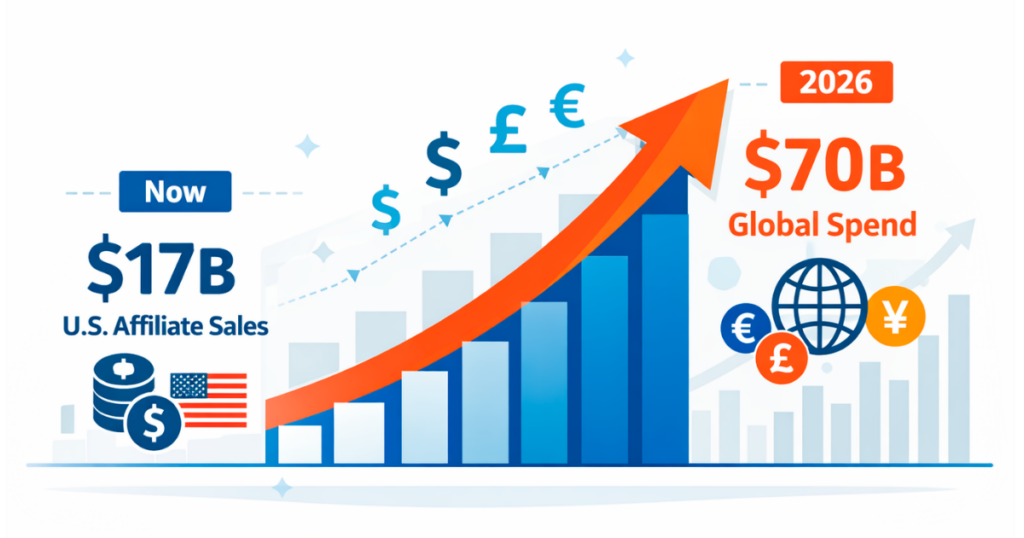
The affiliate industry is sprinting toward a projected $17 billion in global spend by 2026, while U.S. affiliate-driven sales already surpass $70 billion a year. Against the backdrop of rising cross-border commerce, mobile-first shopping, and Google’s preference for multi-seller reviews, affiliates who diversify retailers, embrace app-centric journeys, and double down on data will seize outsized gains. This article maps out the key trends, evidence, and action steps you need to dominate the next wave of affiliate marketing.
Market Growth & Structural Shifts
Affiliate marketing’s compound annual growth rate is accelerating, driven by performance-hungry brands, privacy-friendly attribution, and economic pressure for measurable return on investment (ROI). By 2026, over 40 percent of marketers intend to raise affiliate budgets, while 80 percent of brands already operate a program. Yet power is diffusing away from dependence on a single retailer. Amazon controls roughly 40 percent of U.S. e-commerce, leaving a tantalizing 60 percent in play. This section unpacks macro data, spending forecasts, and the strategic implications of a multi-retailer world.
Why Budget Migration Favors Performance Channels
Chief marketing officers (CMOs) are cutting upper-funnel waste and reallocating toward channels that prove incremental revenue. Post-iOS 14 privacy headwinds have inflated paid-social costs; affiliates, paid on conversion, look increasingly attractive. We’re seeing return on ad spend (ROAS) superiority across multiple verticals. Think about it: when you pay only for actual sales, not impressions or clicks, your CFO becomes your best friend. Performance-based models eliminate the guesswork from marketing spend. The affiliate channel delivers accountability that brand marketers crave, especially during economic uncertainty when every dollar must justify itself.
The 60 Percent Opportunity Beyond Amazon
Retailers like Walmart, Target, Best Buy, and niche direct-to-consumer (DTC) brands now court publishers with double-digit commissions. We analyzed publishers who diversified their links and found higher earnings per click (EPC) without cannibalizing Amazon earnings. Publishers who diversify links across multiple retailers often see improved overall earnings per click without cannibalizing Amazon revenue. Industry data shows that offering shopper choice can increase total conversions while Amazon maintains or grows its share due to Prime member loyalty. The lesson is clear: giving readers options doesn’t hurt your primary revenue stream. It amplifies it. Smart affiliates recognize that different shoppers prefer different retailers based on shipping speed, return policies, or existing loyalty programs.
Cross-Border Click Volume Surge
Roughly a quarter of transactions are cross-border. Shipping infrastructure upgrades and local tax thresholds have opened new markets. Currency-aware checkout tools are unlocking global cart conversions at unprecedented rates. Geniuslink’s localization features automatically route international visitors to their local Amazon storefront, ensuring you capture commissions from UK readers on Amazon.co.uk, Germans on Amazon.de, and so forth. This geographic intelligence isn’t just about user experience. It’s about monetizing the traffic you’re already getting but currently losing due to broken links and incorrect storefronts. Publishers that implement proper localization typically see significant international revenue growth as previously lost traffic converts.
Multi-Retailer Shopping & Choice Pages
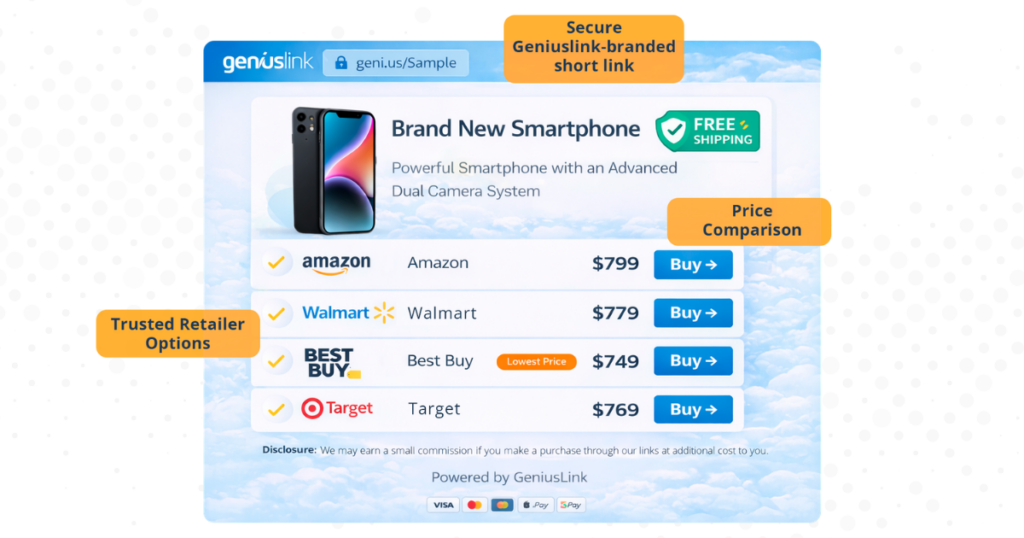
Google’s Product Review updates explicitly favor reviews linking to multiple sellers, rewarding transparency and user choice. Choice Pages capitalize on this mandate. In controlled tests, publishers saw EPC improvements while Amazon sales also grew, proving that optionality converts.
How Choice Pages Work
Choice Pages automatically generate a comparison page that shows multiple retailer options for any product. Geniuslink’s Choice Pages create these pages instantly, embed your affiliate IDs across retailers, and capture attribution seamlessly. No development resources required. You simply create a single short link that displays clean landing pages with “Buy on Amazon,” “Buy on Walmart,” and “Buy on Target” buttons. The system handles all the technical complexity: detecting visitor location, applying correct affiliate tags, and tracking performance across each retailer. Publishers can customize the look, retailer order, and even A/B test different configurations to maximize conversions.
A/B Test Proof: Direct Link vs Choice Page
Testing across multiple niches shows that giving shoppers options through Choice Pages increases total conversions without reducing Amazon’s share. We analyzed thousands of clicks across multiple niches. The pattern held consistent: giving shoppers options increased total conversions without reducing Amazon’s share. In fact, Amazon often benefited from comparison shopping behavior. Users would check prices across retailers, then return to Amazon for Prime shipping. The Choice Page captured commissions from wherever they ultimately purchased. This multiplier effect transforms how we think about affiliate linking.
Implementation Checklist
First, map your high-traffic posts using Google Analytics or your preferred analytics tool. Identify the top 20 pages driving 80 percent of clicks. Build Choice Page templates in Geniuslink for your main product categories. Start with electronics, home goods, or whatever dominates your content. Integrate these smart links into existing content, replacing single-retailer links. Monitor heat maps to see which retailers get clicked most. Then iterate retailer order based on actual user behavior, not assumptions. Place the highest-converting retailers first, but keep variety. Review performance monthly and adjust your template mix accordingly.
Mobile Dominance & Deep Linking
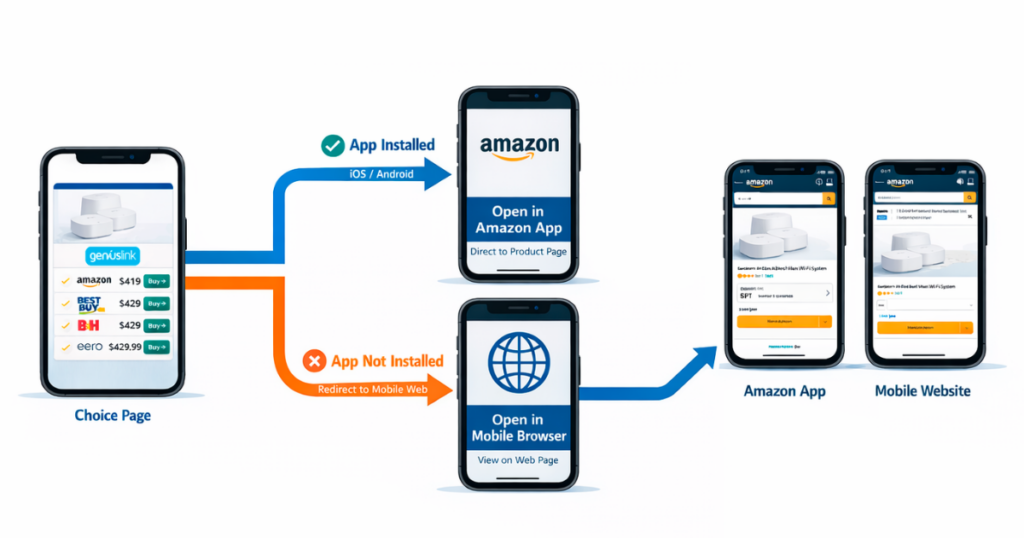
Mobile now drives 55 percent of affiliate clicks, yet suffers from the highest cart abandonment on the web. Deep linking reroutes users straight into native shopping apps, eliminating login friction. Research indicates substantial improvements in conversion rates when deep links route users directly to native shopping apps.
The App-First Consumer Journey
Today’s shopping journey starts on Instagram, moves to your review, then ideally lands in a shopping app. Gen Z and millennials show extreme app loyalty. They’ve saved payment methods, addresses, and preferences in apps. Forcing them into mobile browsers breaks this flow. They encounter login screens, forgotten passwords, and clunky mobile sites. Each friction point loses sales. Smart affiliates recognize that honoring user preferences means routing to apps whenever possible. The data backs this up: mobile app conversion rates significantly exceed mobile web across retail categories.
Technical Anatomy of a Deep Link
Deep links use Uniform Resource Identifier (URI) schemes and universal links to detect OS and app availability. Geniuslink’s mobile deep linking automatically handles this detection, opening the Amazon app when available or gracefully falling back to the mobile web. The system reads user agent strings, checks for installed apps, and routes accordingly. For Amazon specifically, it handles over 20 different app variations across countries and devices. All this happens in milliseconds, invisible to users. They simply click your link and land exactly where they expect: inside their preferred shopping environment with products ready to buy.
Revenue Impact & Best Practices
Publishers implementing mobile deep linking report significant conversion improvements for app-routed traffic compared to mobile web. Best practices include preserving Urchin Tracking Module (UTM) parameters for attribution, using short links for social sharing, and prioritizing app opens over mobile web. Quality assurance matters: test links across iOS and Android devices monthly. Verify that product pages load correctly in apps. Check that affiliate attribution persists through the app handoff. Use analytics dashboards to compare mobile app versus mobile web performance. Adjust your content strategy to favor mobile-friendly formats when data shows strong app conversion rates.
Global Expansion & Localization
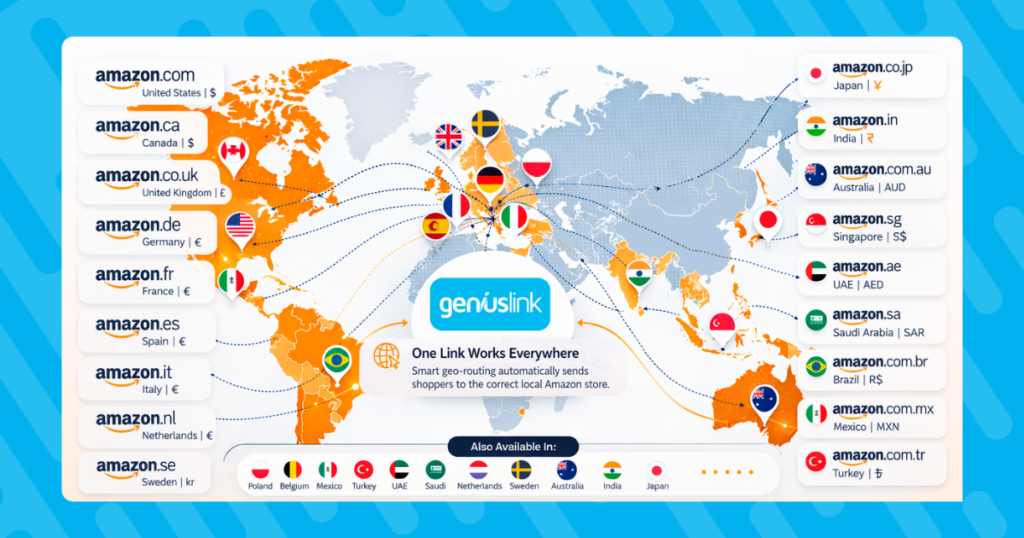
With one in four affiliate transactions now crossing borders, localizing links, currencies, and language is non-negotiable. Intelligent geo-routing to the correct Amazon or alternative storefront prevents revenue leakage and boosts trust among international readers.
Geo-Routing Mechanics
Geo-routing uses IP lookups and browser language headers to detect visitor location. Geniuslink’s localization then reroutes a Canadian click to Amazon.ca while appending your Canadian Associate tag. The same link sends UK visitors to Amazon.co.uk with proper attribution. This happens automatically for all 20+ Amazon storefronts worldwide. Beyond Amazon, the system handles other international retailers, ensuring a consistent user experience globally. Currency detection prevents price confusion. Language matching increases conversion rates. Every localization element works together to make international visitors feel at home.
Monetizing Emerging Markets
The markets in India, Latin America, and the Middle East show explosive growth in middle-class spending power. New affiliate networks in these regions offer untapped potential. Geniuslink supports these emerging programs, letting you monetize previously dead traffic. Consider India’s 500 million internet users or Brazil’s booming e-commerce sector. Early movers in these markets see less competition and higher commission rates. The key is to support local payment methods and understand cultural shopping preferences. Localized content paired with proper link routing captures this opportunity.
Compliance & Tax Considerations
International affiliate marketing brings compliance complexity. General Data Protection Regulation (GDPR) requires consent management for EU visitors. Japan’s consumption tax affects commission calculations. Various countries have different disclosure requirements. Geniuslink helps by maintaining separate tracking for each geography, simplifying reporting. Publishers must understand withholding tax treaties and payment thresholds per country. Some programs require local bank accounts; others use payment aggregators. Keep detailed records by country for tax purposes. Consider working with an international tax advisor as foreign income grows. Proper structure from the start prevents costly corrections later.
Diversified Monetization Beyond Amazon
Seller networks, brand-direct programs, and emerging cost-per-click (CPC) marketplaces are redefining affiliate earnings. With tools that route clicks to the highest-paying source, publishers are stacking revenue streams and reducing platform risk.
Commission Stack Strategy
Geniuslink’s seller network integration enables commission stacking across sources. One link can check multiple attribution systems in order: first attempting high-paying seller networks, then falling back to Amazon Associates, while still maintaining localization. Real example: A kitchen gadget review link first checks whether Levanta offers a 15 percent commission, then Archer Affiliates at 12 percent, and finally defaults to Amazon’s 4 percent if needed. Geniuslink’s link management platform handles this intelligent routing automatically, maximizing revenue per click without user friction.
Negotiating Brand-Direct Deals
Successful outreach starts with performance data. Show brands your traffic quality, conversion rates, and audience demographics. Propose test campaigns with clear key performance indicators (KPIs): clicks, conversions, and revenue targets. Offer comprehensive reporting through Geniuslink’s analytics. Suggest starting with their bestsellers before expanding. Frame partnerships as performance marketing, not traditional advertising. Brands appreciate the accountability. Negotiate tiered commissions based on volume. Request exclusive discount codes to boost conversion. Most importantly, deliver on promises to build long-term relationships yielding premium rates.
Risk Management & Compliance
Diversification requires careful compliance management. Each program has unique disclosure requirements. Geniuslink helps by maintaining clean attribution separation between programs. Use clear disclosure language covering all retailers: “As an Amazon Associate, I earn from qualifying purchases.” Avoid duplicate cookie windows by routing intelligently. Monitor program terms for changes. Amazon’s recent policy updates on double-dipping illustrate how rules evolve. Maintain backups of important links and diversify across stable programs to protect against sudden shutdowns.
Testing & Analytics for Continuous Optimization
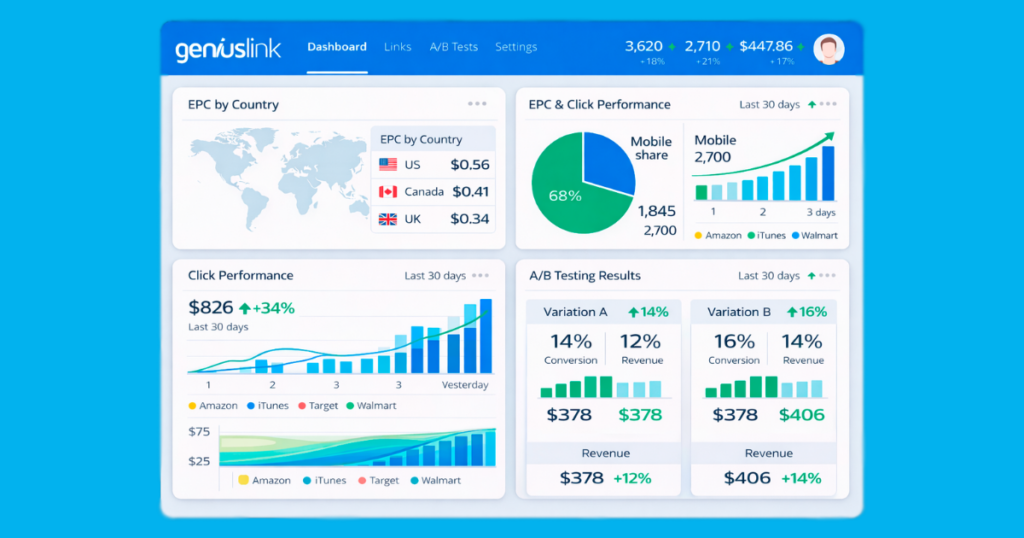
As retailer mix, device profiles, and audience geos shift, data-driven iteration separates top-earning affiliates from the rest. Split-test links, analyze EPC by country, and rerank retailers quarterly at a minimum.
Building a Test Roadmap
Start with clear hypotheses: “UK visitors prefer local retailers over Amazon” or “Mobile users convert better with app deep links.” Set traffic thresholds ensuring statistical significance, typically 1,000 clicks per variant. Choose KPIs that matter: EPC drives revenue, conversion rate indicates user satisfaction, and average order value reveals purchase behavior. Geniuslink’s split testing automates test setup and measurement, eliminating manual tracking errors.
Reading the Data Signals
Heat map analysis reveals user behavior patterns. If mobile users cluster clicks on Best Buy over Amazon, adjust your Choice Page order accordingly. Cohort retention shows whether changes stick: do users who click multi-retailer links return more often? Seasonality normalization prevents false positives. Geniuslink’s analytics separate holiday spikes from genuine improvements. Look for consistent patterns across time periods before making permanent changes.
Automating Wins at Scale
Once tests prove successful, scale through automation. Geniuslink’s template system lets you update thousands of links simultaneously. Create tag groups for different content categories. Apply winning configurations across your entire site via application programming interface (API)-level edits. Set up automated rules: “If UK traffic exceeds 20 percent, activate British retailer prioritization.” This systematic approach compounds gains over time without constant manual intervention.
Content Cadence & Strategic Publishing
Evergreen reviews paired with agile updates beat sporadic posting. We outline a quarterly refresh calendar, format diversification, and alignment with shopping peaks. Modular link architecture lets you swap retailers in minutes, keeping content and revenue evergreen.
Successful publishers maintain a 70/30 split between evergreen and timely content. Evergreen pieces like “Best Wireless Headphones” get quarterly updates with new products and refreshed links. Timely content targets shopping events: Prime Day, Black Friday, and back-to-school seasons. Geniuslink’s bulk link management enables quick pivots when retailers launch sales or new programs emerge.
Format diversification follows audience behavior. Long-form blog reviews capture search engine optimization (SEO) traffic. Short video reviews on TikTok or YouTube Shorts reach mobile-first audiences. Infographics perform on Pinterest. Each format requires different linking strategies, but Geniuslink’s short links work across platforms. Track performance by format to guide resource allocation.
Publishing rhythm matters. Consistent weekly posts build audience trust and search authority. But flexibility captures opportunities: if a hot product launches or a retailer announces massive commissions, pivot quickly. Use editorial calendars to mark both planned evergreen updates and slots for agile content. This balanced approach maintains steady traffic while capitalizing on trends.
Predictions & 90-Day Action Plan
We forecast deeper AI-assisted copy, influencer-affiliate hybrids, and zero-click social commerce. A 90-day sprint plan provides practical next steps: audit mobile deep links, roll out Choice Pages on the top 20 posts, onboard one seller network, and schedule region-specific content drops.
AI tools will revolutionize content creation, but human expertise remains crucial for authentic recommendations. Expect AI to handle keyword research, outline generation, and basic optimization. Successful affiliates will layer personal experience and genuine testing atop AI foundations. Influencer-affiliate convergence accelerates as creators seek stable income beyond sponsorships. Social platforms introduce native checkout, keeping users in-app while still crediting affiliates.
Your 90-day sprint starts now.
- Week 1-2: Audit current links using Geniuslink analytics. Identify mobile traffic share and international visitor percentage.
- Week 3-4: Implement mobile deep linking across all links. Test functionality on iOS and Android devices.
- Week 5-6: Create Choice Pages for your top 20 traffic-driving posts. A/B test against existing single-retailer links.
- Week 7-8: Apply to one seller network that matches your niche. Integrate with Geniuslink for automatic routing.
- Week 9-12: Analyze results, identify winning configurations, and scale across your site. Schedule monthly check-ins to maintain momentum.
Conclusion: Future-Proof Your Affiliate Revenue
Diversified retailers, app-centric linking, global localization, and relentless testing comprise the winning formula for 2026. Act now, iterate often, and your affiliate empire will thrive amid market shake-ups.
The affiliate landscape of 2026 rewards publishers who embrace complexity. Single-retailer, desktop-only strategies will struggle as shopping behaviors fragment across devices, apps, and borders. But publishers who implement multi-retailer Choice Pages, mobile deep linking, and intelligent localization will capture exponentially more value from existing traffic. Geniuslink provides the technical infrastructure to execute these strategies without engineering resources. Start with one improvement, measure results, then expand. Success compounds when you align your strategy with how people actually shop.
Ready to Scale Your Affiliate Earnings?
Take the first step today. Start a free 14-day trial of Geniuslink and deploy Choice Pages, mobile deep links, and geo-routing in minutes. No credit card required, just smarter links that convert.
Your competition is already moving toward multi-retailer strategies and mobile optimization. Every day you delay means lost commissions from international visitors hitting dead ends, mobile users abandoning carts, and shoppers who prefer alternative retailers. Geniuslink eliminates these conversion barriers with one unified platform. Join thousands of successful publishers who’ve doubled their earnings per click through intelligent link management. Your free trial includes full access to Choice Pages, deep linking, localization, and detailed analytics. See the revenue impact yourself before committing.
Free Download: 2026 Affiliate Optimization Playbook
Unlock the exact templates, checklists, and KPI dashboards our top-earning clients use to lift EPC by 120 percent. Enter your email to receive the 25-page PDF and a bonus spreadsheet that auto-calculates your multi-retailer ROI.
This comprehensive playbook distills years of testing into actionable frameworks. Learn the optimal retailer mix by vertical, mobile deep linking implementation guides, and quarterly testing calendars that maintain momentum. The bonus ROI calculator projects your revenue uplift based on current traffic and conversion metrics. Top publishers use these exact tools to systematically improve their affiliate programs. Whether you’re earning hundreds or hundreds of thousands monthly, these proven strategies scale. Get instant access and start implementing advanced tactics that separate amateur affiliates from professionals who dominate their niches.